Fiction. Every person, brand and business named here is invented.
My name is Douglas Kerr and my job is to find rooms that look like other rooms.
The official title is lifestyle location scout. What I actually keep is a spreadsheet called the Ledger, which holds 1,340 interiors across the north-west, each one photographed at three times of day and rated for read-through: whether a stranger, given about a second and a bit, accepts the room as a home belonging to a person they already have opinions about. Read-through is the whole business. Nothing else in the Ledger matters if the room takes two seconds.
07:10 — the Ledger
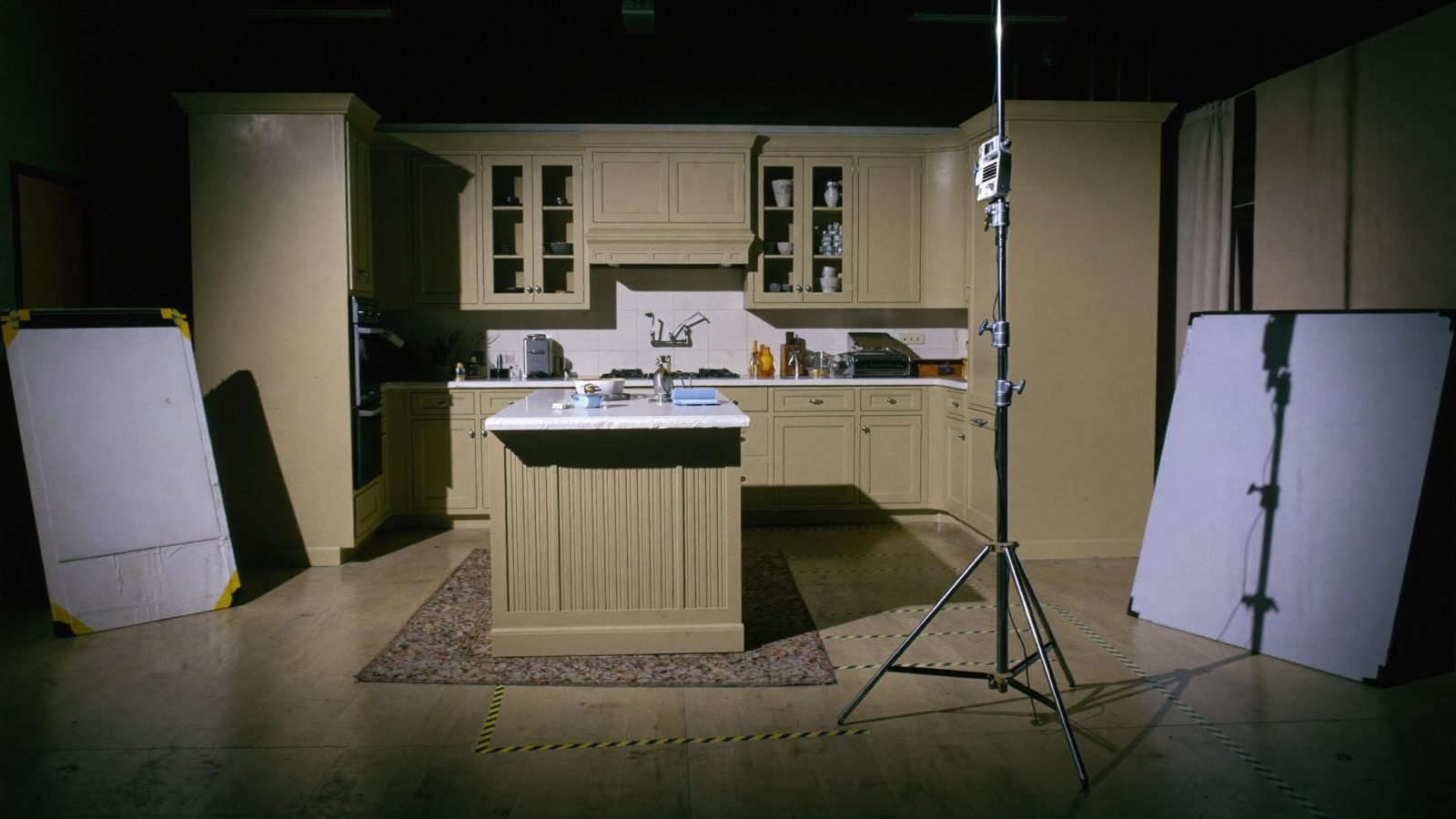
The tags are not romantic. LIGHT-N-SOFT. FLOOR-HONEST. CLUTTER-PLAUSIBLE. NO-CONSERVATORY-VISIBLE. I have four categories of kitchen and I can defend all four. Achievable Scandinavian is a kitchen the audience believes they could reach in nine years. Aspirational Scandinavian is a kitchen they believe they could reach if something happened to a relative. Aspirational Unachievable has an island the length of a small car and is booked almost exclusively for content about being tired. The fourth category is Aspirational Unachievable, Denies It, and it is the busiest by a distance.
Three briefs this morning. A hydration brand called Sarne wants, in writing, “a kitchen that feels like it belongs to someone slightly less successful than the talent”. That is a downgrade. Downgrades bill better than upgrades because you are removing rather than sourcing, and removal is billed by the hour.
08:40 — Kitchen 214, Sale
Kitchen 214 belongs to a couple who both work shifts and who have, over four years, become extremely good at leaving. I have a key. They are paid £220 for the day and I am contractually obliged to describe them as the homeowners rather than the location, which is a distinction that matters to nobody except their insurer.
First job is the fridge problem. Every real fridge is covered in things that identify a real family: a school letter, a hospital appointment card, a magnet from somewhere. All of it comes off and goes into a labelled bag, and then about a fifth of it goes back on, chosen for being unreadable at distance. A bare fridge reads as a rental. A full fridge reads as a life somebody else is already living. The trade calls the correct amount the second-home tell, in the negative — you are removing the tells that say nobody sleeps here.
Second job is the honest window. An honest window gives you north light and shows you nothing. Kitchen 214 has one, which is why it is in the Ledger. The window above the sink shows nine feet of a neighbour’s rendered wall, and a rendered wall photographs as sky if you underexpose it slightly, and I have never once been asked what is out there.
11:15 — the chaos dress
In the van I carry a crate that has been described by a client as “the soul”. It contains:
- Forty-one children’s drawings, commissioned in batches from a man in Oldham at £4 each, unsigned, undated, deliberately not very good.
- A laundry basket that is permanently three-quarters full of clean laundry nobody has ever worn.
- Thirteen candles burnt to varying depths using a heat gun on a Sunday.
- One throw, described on the invoice as “lived-in”, dry-cleaned weekly.
- Two mugs that do not match, which cost more than the eight that do.
A chaos dress takes about fifty minutes. The rule is that the clutter must be plausible but not narrative — the moment a viewer starts wondering who left the shoe there, the room stops being a home and becomes a set. I have watched people spend two hours arranging a room into a story, and the story is always the thing that gets it rejected.
13:00 — the van
I eat a sandwich in the van outside a house that is being paid £220 to look like a house where somebody eats a sandwich. I am aware of this. It is not as funny on the ninth year as it was on the first.
14:20 — the neighbour
Number 216 gets £40 in cash and a note through the door the week before. This is called goodwill and it is the single best-value line on any budget I have ever run. Without it you get a car moved onto the frontage at 09:00, a strimmer at 11:00 and an angle grinder at any point in the afternoon. I also make a note of the dog. Every location in the Ledger has a dog field. The dog field has saved more shoots than the lighting has.
16:00 — the paperwork
The invoice for the day, which will be approved without comment inside four minutes:
- Location hold, 8h, K214 — £220.00
- Scout fee, day rate — £340.00
- Downgrade, kitchen, standard — £95.00
- Plausible clutter, dressed and struck — £60.00
- Goodwill, adjacent property — £40.00
- Bin relocation and return — £15.00
- Congestion, parking dispensation, fuel — £47.30
Bin relocation is fifteen pounds and it is the line clients query most often. I have been asked three times whether the bins could be moved by the talent. They could. They will not be.
18:30 — home
My own flat photographs badly. There is a radiator under the only good window, the ceiling is 2.2 metres, and the light in the front room turns everything slightly green after four o’clock. It is not in the Ledger and it never will be. I am not being precious about it. It genuinely does not read.
My daughter is eleven and tells people I find nice places for people to stand, which is accurate and which I have stopped correcting.
The kitchen I am proudest of is 041, a small terraced kitchen in Stockport that I put on the books in 2019 for a pasta brand. It has appeared, by my count, in somewhere north of four hundred pieces of content. Two years ago the family who own it repainted, and I went round to re-photograph, and they had matched the new colour to a photograph. Not to a swatch. To a photograph of their own kitchen, taken by somebody else, for somebody else, on a Tuesday, for £220.
They said it looked better in the pictures. They were right. It does.