
The MachineDocumented7
Who pays for the candid photo
A publicist says he paid a star $50,000 for a couple of street shots. A declared sponsored post from the same tier costs over $1M. That gap explains the whole staged-candid economy.
$15,000 → $10
Fifty thousand dollars for a couple of shots of somebody walking down a street.
That figure comes from Tyler Williams, chief executive of the publicity firm Nouveau Communications, who told Bustle he had paid “a star $50,000 for a couple shots”. His point was not that the number is large. His point was that it is small. A sponsored Instagram post from the same tier of talent, he said, costs “well over $1 million”.
That gap — one deal at $50,000, the equivalent declared advert at more than twenty times the price — is the entire economic engine of the staged candid. Everything else in this piece is a consequence of it.
What “candid” costs to manufacture
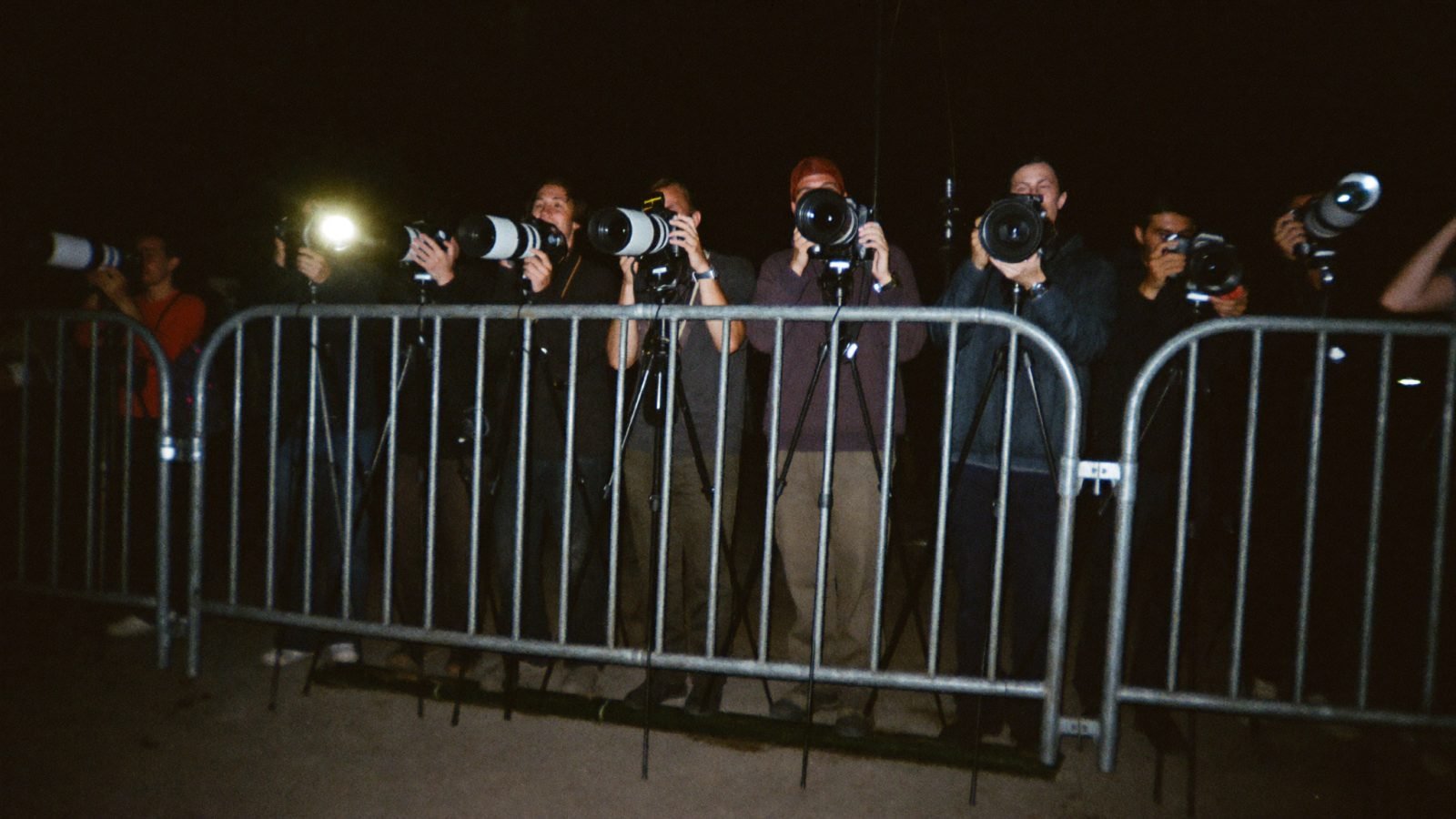
Start with the people who make the pictures. A veteran Los Angeles street-style photographer, identified by Bustle only as “John”, described how event photography actually works: “When people are going to an event, [the paparazzi] is set up.” And, more bluntly: “Those shots don’t exist unless they’re sort of planned.”
A named paparazzo, Cesar Peña of 247PapsTV, told the same publication he had coordinated directly with Justin Bieber’s side, and offered an observation about the most photographed woman in America: “Candid shots of her are very rare,” he said of Kim Kardashian.
Williams described the production process from the buyer’s end, and it reads like any other advertising shoot. Stylists request specific locations. Photographers coordinate timing with the celebrity’s team. Brands approve concepts in advance. Photographers guarantee placement.
Approve concepts in advance. Guarantee placement. Those are media-buying terms. They are not words that survive contact with the idea of a chance encounter.
An important limit on what any of this proves
It would be easy, and wrong, to move from those quotes to a list of names.
So, plainly: STAGED found no on-the-record admission by any named A-list celebrity that they arranged paparazzi coverage of themselves. Hailey Bieber has publicly denied doing it. Where a specific person is accused of calling a photographer on themselves, the claim is, with rare exceptions, unproven — and an unproven claim about an individual is not improved by being repeated confidently.
What is on the record is an industry describing its own working practice. Photographers say arranged shoots happen. A publicist says he has paid for one. Those accounts are self-reported and they describe a market that exists. They do not identify who is in it.
The $50,000 figure deserves the same care. It is one publicist’s account of one transaction. It is not a rate card, and nobody should treat it as a market price.
Why the money moved to the street
To understand why brands would buy a photograph of somebody walking, look at what happened to the photographs themselves.
Fstoppers reported in April 2019, drawing on the paparazzo Santiago Baez, who has worked since 1990, and Peter Grossman, photo editor at Us Weekly from 2003 to 2017, that exclusive “Just Like Us”-style images which once sold for $5,000 to $15,000 had come to sell for $5 to $10.
Read that again. Not a percentage decline. Three orders of magnitude.
The cause was not falling demand for celebrity images; demand has never been higher. The cause was a change in how the images are licensed. Agencies moved from paying per photograph to subscription licensing, in which an outlet pays a flat fee for access to the feed. Once a publisher’s cost per picture approaches zero, so does the photographer’s revenue per picture. Photographers take somewhere between 20% and 70% of royalties, depending on exclusivity and their agency’s terms — a wide band, and a percentage of a very small number is a very small number.
The exception proves the structure. Genuinely unrepeatable images still command real money: the Kristen Stewart and Rupert Sanders set sold, per the same reporting, in the mid six figures. Scarcity still pays. Volume does not.
What a celebrity photograph has been worth
- ~$250 from TV tabloid shows, ~$125 from supermarket tabloids, $750 for a cover — Los Angeles Business Journal, 31 August 1997
- $5,000–$15,000 — an exclusive “Just Like Us” shot, before subscription licensing (Fstoppers, April 2019)
- $5–$10 — the same category of shot after it (Fstoppers, April 2019)
- 20–70% — the photographer’s share of royalties, depending on exclusivity and agency terms
- $50,000 — one publicist’s account of one arranged shoot; not a market rate
- “Well over $1 million” — the same publicist’s figure for a declared sponsored post from comparable talent
For historical scale: the Los Angeles Business Journal, writing on 31 August 1997 in the immediate aftermath of Princess Diana’s death, reported a typical celebrity photograph fetching around $250 from television tabloid shows and around $125 from supermarket tabloids, with covers at $750, down from $1,400. Court photographers billed $1,000 to $2,000 a day. That is nearly thirty years old and belongs in the story only as a baseline — but it tells you the per-picture business was already thin long before the internet finished it.
The surveillance model it replaced
The old model was brute cost. According to a Priceonomics account of the business, one firm logged more than 40,000 man-hours watching Britney Spears, producing something like $6 million in photo revenue. X17, described there as the largest agency, employed around 70 shooters on $800 to $3,000 a week plus bonuses. The record-setters cited include $14 million for the Jolie–Pitt newborn twins, donated to charity, and more than $1 million for the Zeta-Jones and Douglas wedding.
Those numbers come from a secondary aggregation rather than primary accounts, and we would not want any single one of them carrying weight on its own. Directionally, though, the shape is clear: the industry once spent enormous sums on waiting, and the waiting was justified by what a single unrepeatable frame could earn.
When the frame is worth $8, nobody can afford to wait. The only economically rational photograph left is the one somebody has already agreed to pay for.
The information problem
Waiting is not the only way to find someone. Sometimes the location arrives by email.
Virgin Atlantic launched an investigation after The Guardian reported that an employee had passed confidential flight details of celebrity passengers to the London paparazzi agency Big Pictures, using a private email account. The passengers whose travel was allegedly leaked included Madonna, Sienna Miller, Princess Beatrice, Russell Brand, Daniel Radcliffe, Scarlett Johansson, Gwyneth Paltrow, Rihanna, Robbie Williams, Ashley Cole and Hugh Grant. Big Pictures’ founder, Darren Lyons, had given evidence to the Leveson Inquiry earlier that year.
Two cautions, and they matter. This is an allegation. The employee resigned after being contacted by The Guardian; no finding of fact was ever published, and no payment amount was ever reported. What the episode documents is not a proven crime but a plausible pipeline — the existence of a market in knowing where somebody will be.
How to read a photograph
The reporting on staged shots yields a consistent set of tells. None is conclusive alone. Together they are suggestive.
The credit repeats
Arranged work tends to run through relationships, so the same byline recurs on the same subject. Bustle’s reporting names the photographer Miles Diggs as known within the industry for staged work.
The styling is too good
Hair and make-up that are “too perfect” for the stated activity. A fully styled look for a casual walk near home is a costume, not an outfit.
The framing is too generous
Genuine long-lens work is cropped by circumstance: obstructions, bad angles, other people’s heads. Arranged shots tend to have clean, usable space around the subject — the framing of a photographer who knew where to stand.
The caption does the selling
The tell that costs nothing to check. A supposedly incidental street photograph accompanied by copy naming a specific shop, label or product is not a street photograph. It is a placement, and the caption is the media buy.
That last tell is also where the law arrives. The US Federal Trade Commission’s Endorsement Guides, revised in 2023, require anyone paid or given something of value to promote a product to disclose it “clearly and conspicuously”, and require the disclosure to name the brand. The Guides do not contain an exemption for material that looks like journalism, and they do not contain one for photographs that look accidental.
Which leaves the arithmetic where we started. A declared advertisement from top-tier talent, per one publicist, costs well over $1 million. An arranged photograph that reads as an accident costs a fraction of that, and buys something the advert cannot: the appearance of not having been bought at all.
That premium — the discount on credibility — is the product. Everything else is logistics.
Sources
- Bustle: photographers and a publicist on how staged celebrity street shots are made
- Fstoppers on paparazzi economics, subscription licensing and royalty splits (28 April 2019)
- Priceonomics on the surveillance economics of the paparazzi business (secondary aggregation)
- Los Angeles Business Journal's 1997 celebrity photo rate card
- NBC News: Virgin Atlantic investigates alleged tip-offs to a paparazzi agency
- FTC's Endorsement Guides: What People Are Asking (revised 2023)
- FTC Notices of Penalty Offenses concerning endorsements
More from this section
The MachineDocumented12
The $35-an-hour private jet
A plywood fuselage in Boyle Heights rents for less than dinner. A real grounded Gulfstream costs twelve times more. The economics of…
The MachineDocumented12
The disclosure rules everyone is breaking
$53,088 per violation, a 5-0 vote, more than 700 companies already on notice - and, so far, not a single penalty judgment…
The MachineDocumented9
The wardrobe is rented, and that’s a real industry
$45 a month for a Chanel bag. $50 an hour for the room. $425 an hour for a jet that never leaves.…