Case FilesDocumented12
The follower factory: what a fake audience actually costs
Followers cost about a cent each. Clicks cost less. Here is the documented price list, the two regulators who called it illegal, and the honest limits of the data.
1¢
Seventeen dollars bought a thousand of the good ones: English-language accounts with profile photos, the kind that survive a glance. The ordinary ones went for roughly a cent each.
Those prices are not estimates. They were reported directly by The New York Times on 27 January 2018 in “The Follower Factory”, by Nicholas Confessore, Gabriel J.X. Dance, Richard Harris and Mark Hansen, which documented the reseller Devumi’s pricing and its customer records.
Eight years on, that investigation and the two regulatory actions that followed it remain the most solid pricing data in the field. Almost everything published since is worse.
The price list
Devumi, the Times reported, had more than 200,000 customers and had supplied more than 200 million Twitter followers.
Named customers identified in the reporting included Kathy Ireland, John Leguizamo, Michael Dell, Ray Lewis, Clay Aiken, Lori Greiner, Hilary Rosen, Louise Linton and Martha Lane Fox. Their purchases were confirmed by transaction records; several disputed knowing what it was they had bought.
Two customers spoke on the record and between them defined the argument. The actress Deirdre Lovejoy: “Everyone does it.” The Olympic rower James Cracknell: “It’s fraud… it’s not a healthy thing.”
The economics are the point. At a cent a follower, 100,000 followers is a $1,000 line item. Set that against what a six-figure account can charge for a single sponsored post and the arithmetic is not close.
Documented prices, with dates
- Roughly one cent per Twitter follower — NYT, January 2018
- $17 per 1,000 for “high-quality” English-language bots with profile photos, under two cents each — NYT, January 2018
- Less than one cent per click, view or interaction, advertised online by Hanoi click farms — Jack Latham, fieldwork 2023
- About $1.50 per follower — Hootsuite reported paying $500 for roughly 335 followers over four weeks from a “premium growth management” vendor (a vendor’s own blog experiment, not independent research)
- Free — engagement pods, paid for in reciprocal labour rather than cash
Two regulators, two theories
On 30 January 2019 the New York Attorney General’s office announced what it described as the first finding in the United States that selling fake social media engagement is illegal. Then-Attorney General Letitia James settled with Devumi LLC, DisruptX Inc., Social Bull Inc. and Bytion Inc.
The settlement rested on two theories, and both are worth understanding because they cover different victims. The first was illegal deception: misleading consumers, advertisers and the platforms themselves. The second was illegal impersonation: building bot accounts out of real people’s identities without consent.
James: “Bots and other fake accounts have been running rampant on social media platforms, often stealing real people’s identities to carry out fraud.”
The Federal Trade Commission followed on 21 October 2019 with a $2.5 million settlement against Devumi LLC and its chief executive, German Calas, Jr. According to the FTC, Devumi maintained roughly 3.5 million automated accounts, filled more than 58,000 orders for fake Twitter followers and over 800 orders for fake LinkedIn followers, and sold fake likes, follows, views and subscribers across Twitter, LinkedIn, YouTube, Pinterest, Vine and SoundCloud. Thousands of the bot accounts used personal details scraped from real users.
Both matters were settlements. Neither is a judicial finding of liability after trial. But between them they establish the regulatory position clearly: the sale of fabricated engagement is treated as deception of the advertising market and, where stolen identities are involved, as impersonation of the people whose photographs and biographies were harvested.
The factory floor
The supply side has been photographed from the inside.
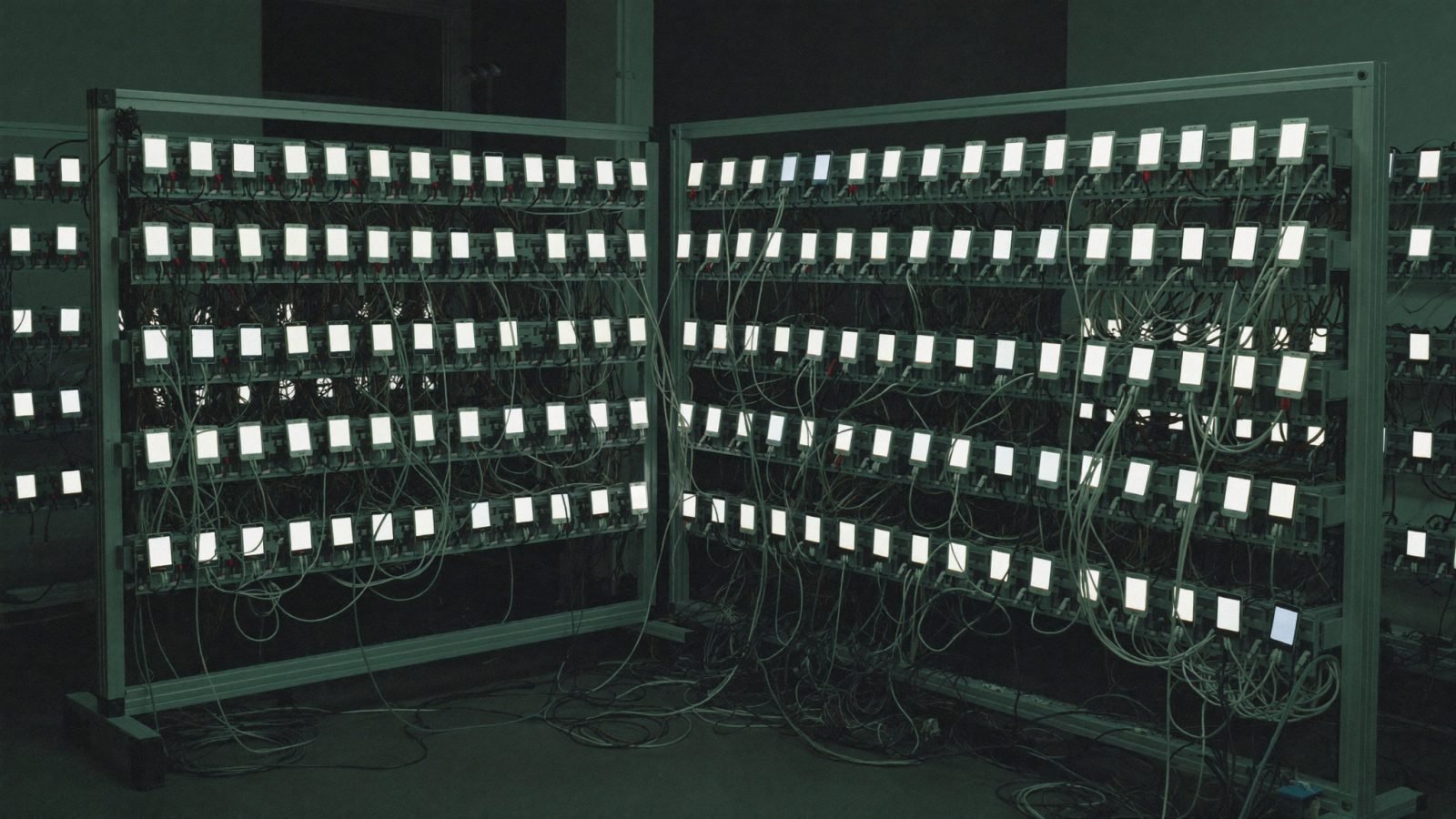
The British photographer Jack Latham spent a month in Hanoi in 2023 and gained access to five click farms, work published in his 2024 book Beggar’s Honey and reported by CNN. He documented two architectures. The first is what most people picture: hundreds of manually operated phones, tapped by hand. The second is the industrial version — “box farms”, in which phones are stripped of screens and batteries, wired together and driven from a single computer, so that one operator does the work of roughly 10,000 people.
Latham’s description of the premises is the detail that lands: “They all looked like Silicon Valley startups. There was a tremendous amount of hardware.”
Services were advertised online at less than one cent per click, view or interaction. Latham ran his own test: a post routed through a farm drew more than 6,600 likes, against a normal baseline for him of 50 to 200.
That ratio is the entire economics of the sector in one experiment. A thirty-fold to hundred-fold multiplier on his own baseline, bought for fractions of a cent per interaction.
The unpaid version
Not all fabricated engagement is bought. Some of it is bartered, and the only peer-reviewed account of that trade was published by Victoria O’Meara in Social Media + Society in November 2019.
The study is small and honest about it: 16 semi-structured interviews with self-identified Instagram influencers — 15 women and one man, aged 24 to 41, with follower counts from about 1,000 to 200,000.
Three findings matter. Pods coordinate mutual likes and comments within roughly the first five minutes after a post goes live, timed to the window in which the visibility algorithm decides how far to push it. They operate as clandestine forums for sharing intelligence about algorithm behaviour. And — the finding that connects them to the paid market — they exist substantially to guarantee the metrics that influencers show to advertisers.
One participant, identified in the study as “Sarah”, explained the pressure directly: “Brands are so numbers focused that an algorithm change… can have a dramatic affect on… income.”
That is worth sitting with. The demand for fake engagement is generated by the buyers of real advertising, who pay against follower and engagement counts and then act surprised when those counts are manufactured.
What it costs the buyers, and what nobody can prove now
The most-cited number in this field is $1.3 billion. It is real, and it is old.
It comes from a July 2019 study by the cybersecurity firm CHEQ with Professor Roberto Cavazos of the University of Baltimore, which estimated $1.3 billion in fraud losses against $8.5 billion in global influencer marketing spend — roughly 15 per cent of spend lost to fraud. The methodology combined CHEQ’s proprietary data, examination of fake-engagement service providers, and research and surveys.
CHEQ’s chief strategy officer Daniel Avital argued detection is not hard: “It’s quite easy to understand if their followers are bogus.” Mae Karwowski of the agency Obviously gave the field heuristic: “Say the person has 70,000 followers and they get 100 likes and zero comments per post — that red flag should go up.”
Now the uncomfortable part, and STAGED would rather print it than not.
There is no defensible successor to the 2019 figure. A search for an updated equivalent surfaces confident-sounding statistics — larger loss totals, precise fake-follower percentages, listicles of “influencer fraud statistics” carrying next year’s date. They come from search-optimised content sites with no visible methodology, no named researcher and no institutional affiliation. This publication will not cite them, and any article that does is reporting its own traffic strategy rather than the world.
The best available update is a vendor estimate and should be labelled as one. HypeAuditor data published via Statista puts the share of Instagram influencers “involved in fraud” at roughly 43.17 per cent in 2023 across all tiers, down 2.15 points year on year, rising to 58.5 per cent among mega-influencers and celebrities with more than a million followers. Two caveats travel with those numbers: HypeAuditor’s definition of “fraud” is broad, bundling bought followers, pods and merely suspicious growth patterns; and HypeAuditor sells fraud detection, which gives it a commercial interest in the problem being large.
The rule that exists and has not yet bitten
On 14 August 2024, on a unanimous 5–0 vote, the FTC finalised its Rule on the Use of Consumer Reviews and Testimonials. Among other things it bans the selling and buying of fake social media influence indicators — followers and views — alongside fake and AI-generated reviews, sentiment-conditioned payments for reviews, undisclosed insider reviews and review suppression.
Then-chair Lina Khan: “Fake reviews not only waste people’s time and money, but also pollute the marketplace and divert business from honest competitors.”
The rule matters because a rule violation carries civil penalties where a bare Section 5 violation frequently did not, after the Supreme Court’s AMG Capital Management decision. The Commission had already primed the ground in October 2021 by sending Notices of Penalty Offenses concerning endorsements to more than 700 companies.
As of this compilation, however, no completed FTC enforcement action has produced a penalty judgment under the new rule. On 22 December 2025 the agency sent warning letters to 10 companies, which it did not name, and stated expressly that the letters are not determinations that any violation occurred.
So the honest ledger reads like this. The price of a fake audience is documented and low. The illegality of selling one is established by two regulator settlements. The supply chain has been photographed. The demand is created by advertisers buying metrics. And the total damage to the market has not been credibly measured since 2019.
Sources
- The New York Times, 'The Follower Factory', 27 January 2018
- Paul Weiss client memo on Devumi LLC's $2.5 million FTC settlement
- New York Attorney General settlement with sellers of fake followers, January 2019
- Victoria O'Meara's peer-reviewed study of Instagram engagement pods, Social Media + Society, November 2019
- CNN on Jack Latham's click farm photography and the book Beggar's Honey
- CNBC on the CHEQ and University of Baltimore $1.3 billion influencer fraud estimate
- CBS News on the same CHEQ study
- Statista series on HypeAuditor's share of Instagram influencers involved in fraud
- Hootsuite's published experiment in buying Instagram followers
- FTC final rule banning fake reviews, testimonials and fake influence indicators
- FTC warning letters to 10 companies under the Consumer Review Rule, December 2025
- FTC Notice of Penalty Offenses concerning endorsements, October 2021
More from this section

Case FilesDocumented9
Belle Gibson: the wellness blogger who never had cancer
The Federal Court of Australia fined Belle Gibson A$410,000. The largest single count was not about the cancer she never had. It…
Case FilesDocumented8
$1.26 million for one Instagram post: the SEC crypto ledger
A running tally of the celebrities the SEC has charged over undisclosed crypto promotion, what each one paid, and the FTX defendants…

Case FilesDocumented8
Fyre Festival was a marketing case study before it was a crime
An orange square, 400 accounts, 95% of tickets gone in 48 hours. Billy McFarland got six years. No influencer was ever charged…